> ## Documentation Index
> Fetch the complete documentation index at: https://docs.insecureweb.com/llms.txt
> Use this file to discover all available pages before exploring further.
# Integration guide for Redis
> Redis can be used with streaming solutions such as Apache Kafka and Amazon Kinesis as an in-memory data store to ingest, process, and analyze real-time data with sub-millisecond latency. Redis is an ideal choice for real-time analytics use cases such as social media analytics, ad targeting, personalization, and IoT.
This integration requires a UTMStack agent to work properly. Please, make sure you have installed it before you continue.
> Redis is an open source (BSD licensed), in-memory data structure store, used as a database, cache, and message broker. Redis provides data structures such as strings, hashes, lists, sets, sorted sets with range queries, bitmaps, hyperloglogs, geospatial indexes, and streams. Redis has built-in replication, Lua scripting, LRU eviction, transactions, and different levels of on-disk persistence, and provides high availability via Redis Sentinel and automatic partitioning with Redis Cluster
### 1. Enable Filebeat module
> Linux
```
cd /opt/utmstack-linux-agent/beats/filebeat/ && ./filebeat modules enable redis
```
> Windows
```
cd "C:\Program Files\UTMStack\UTMStack Agent\beats\filebeat\" && filebeat modules enable redis
```
### 2. Configure Filebeat module
> Configure the module configuration file according to the image below. You can find it in the path:
> Linux
```
/opt/utmstack-linux-agent/beats/filebeat/modules.d/redis.yml
```
> Windows
```
C:\Program Files\UTMStack\UTMStack Agent\beats\filebeat\modules.d\redis.yml
```
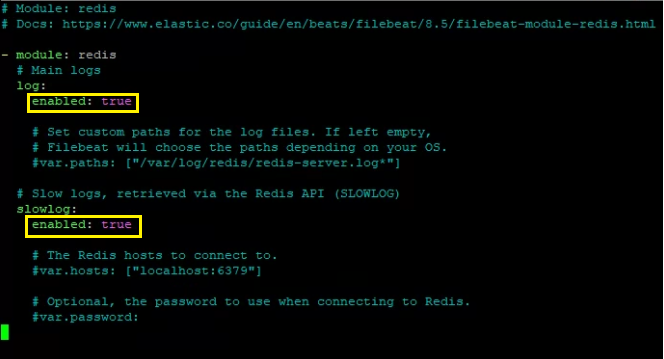 Important!! After a Filebeat module is enabled, the service needs to be restarted using the following command:
> Linux
```
sudo systemctl restart UTMStackModulesLogsCollector
```
> Windows
```
sc stop UTMStackModulesLogsCollector && timeout /t 5 && sc start UTMStackModulesLogsCollector
```
Depending on how you’ve installed Filebeat, you might see errors related to file ownership or permissions when you try to run Filebeat modules. See [Config File Ownership and Permissions](https://www.elastic.co/guide/en/beats/libbeat/8.5/config-file-permissions.html)
### 3. Click on the button shown below, to activate the UTMStack features related to this integration
Important!! After a Filebeat module is enabled, the service needs to be restarted using the following command:
> Linux
```
sudo systemctl restart UTMStackModulesLogsCollector
```
> Windows
```
sc stop UTMStackModulesLogsCollector && timeout /t 5 && sc start UTMStackModulesLogsCollector
```
Depending on how you’ve installed Filebeat, you might see errors related to file ownership or permissions when you try to run Filebeat modules. See [Config File Ownership and Permissions](https://www.elastic.co/guide/en/beats/libbeat/8.5/config-file-permissions.html)
### 3. Click on the button shown below, to activate the UTMStack features related to this integration